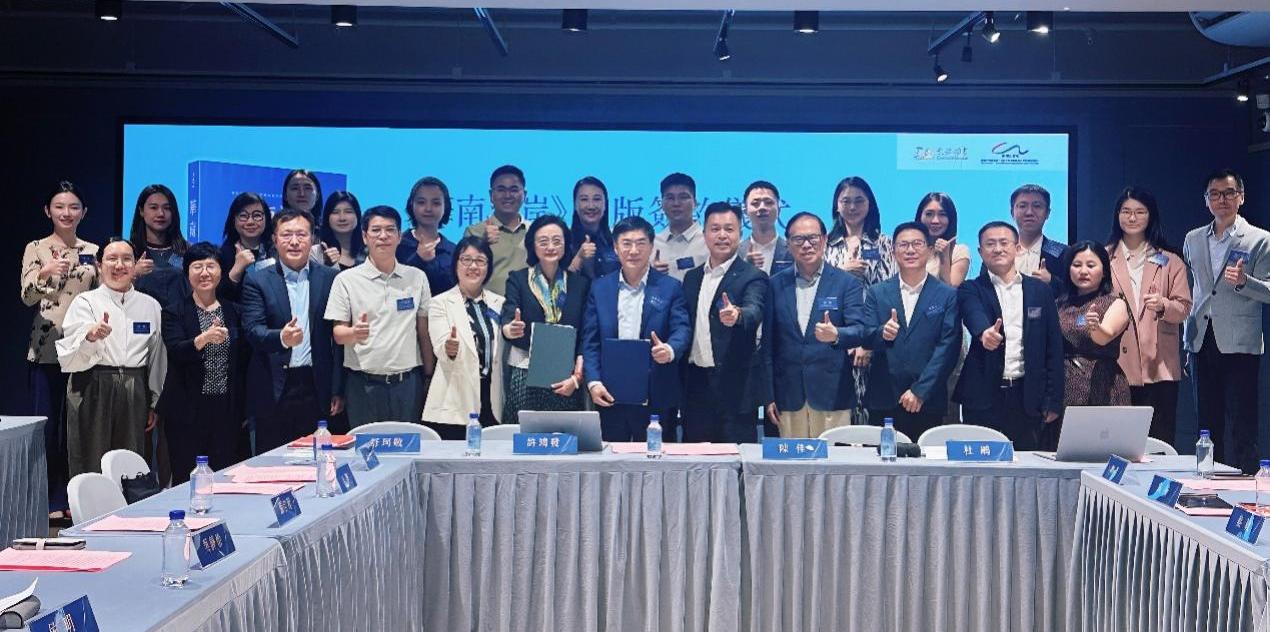
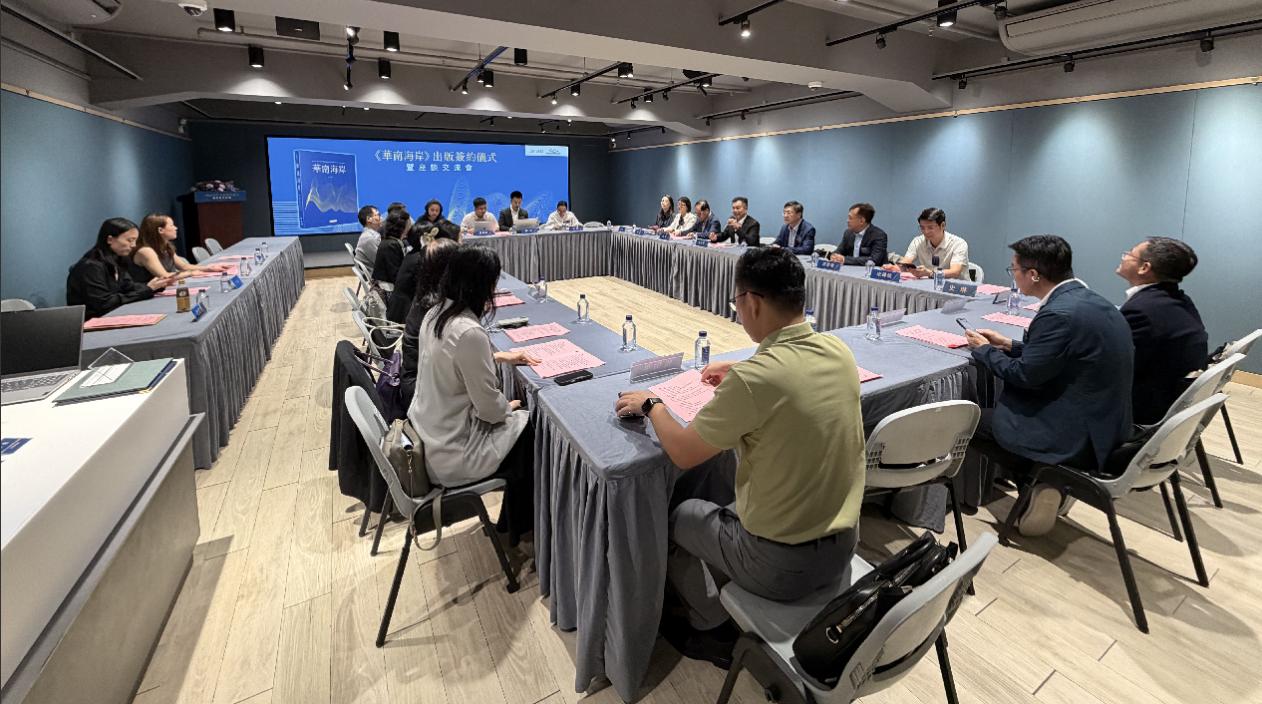
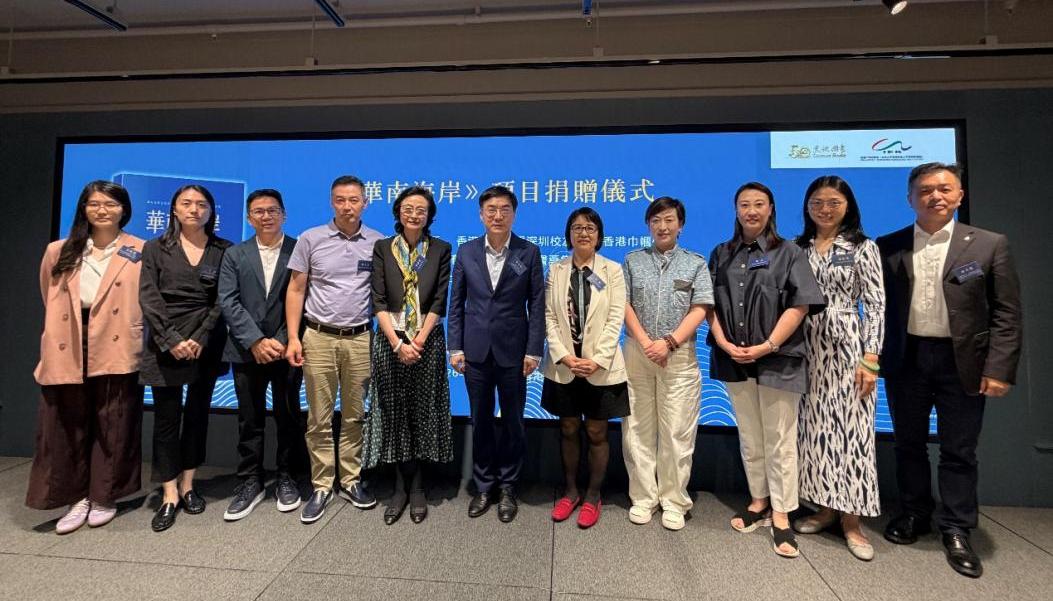
On the afternoon of September 3, 2026, Cosmos Books Ltd., Hong Kong, and the editorial committee of South China Coast: Strategic Vision and Explorations in Theory and Practice for High-Quality Development of China’s Southern Coastal Region held a publishing agreement signing ceremony and discussion at the exhibition hall of the Zhongshang Art Building in Hong Kong. Nearly thirty guests from publishing, academia, science and technology, and business gathered for an in-depth exchange on the strategic vision and coordinated development of the South China Coast Economic Belt.
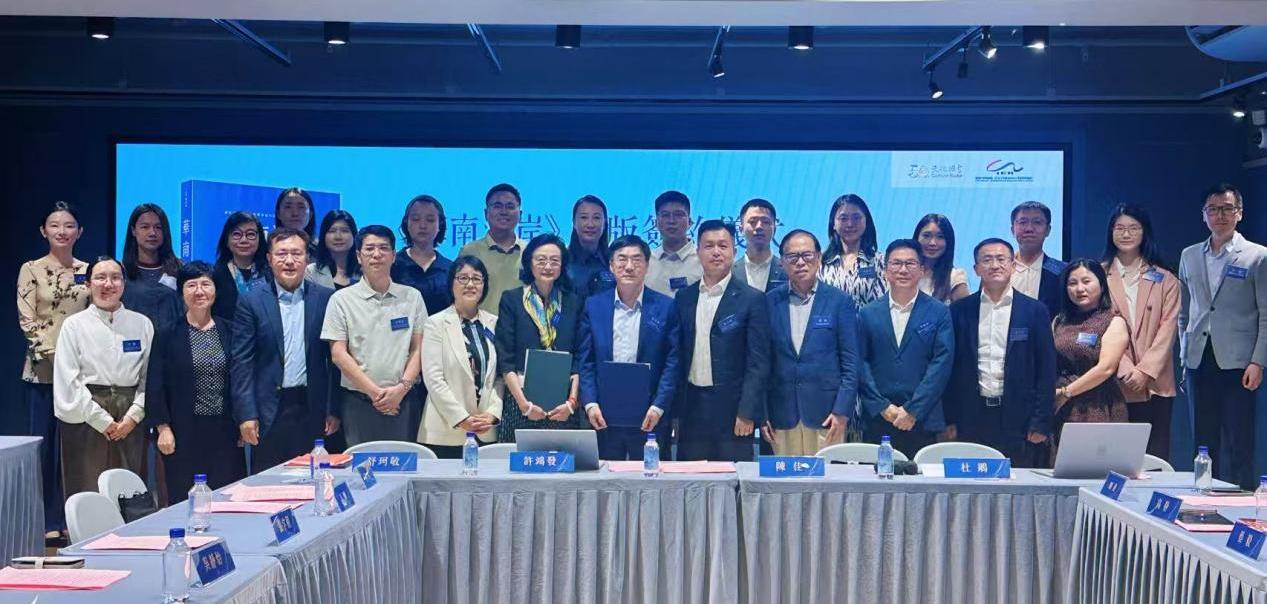
South China Coast is edited by Li Qifeng, Executive Dean of the Shenzhen–Hong Kong Development Research Institute at the Shenzhen–Hong Kong Industry–University–Research Base.
The Shenzhen–Hong Kong Industry–University–Research Base is a public institution at the full bureau level, jointly established in 1999 by the Shenzhen Municipal Government, Peking University and the Hong Kong University of Science and Technology (HKUST). It aims to promote the commercialization of scientific and technological achievements, cultivate high-level talent and conduct research in advanced applied technologies. The Shenzhen–Hong Kong Development Research Institute is a think tank established by the Base’s governing council. Its mission is to bring together resources from Peking University, HKUST and Shenzhen to build an open think tank for regional development; systematically study issues in science and technology, industry, society, law and culture relating to Shenzhen–Hong Kong cooperation and bay area development; and provide objective, forward-looking and actionable public policy and strategic recommendations for the “Shenzhen–Hong Kong Innovation Circle” and the bay area.
Completed over five years by the research team, the book is a major research report released to mark the 20th anniversary of the Shenzhen–Hong Kong Development Research Institute. Comprising 300,000 Chinese characters, it is divided into three parts: “Strategic Vision,” “Quantitative Research” and “Action Strategy.” Following a progression of “diagnosis—comparative lessons—quantification—action,” it systematically assesses the current development and potential for cooperation across the six constituent regions of the South China coast. It proposes spatial restructuring “from the bay area to the coast” as a strategic route to overcoming constraints on the Greater Bay Area’s development.
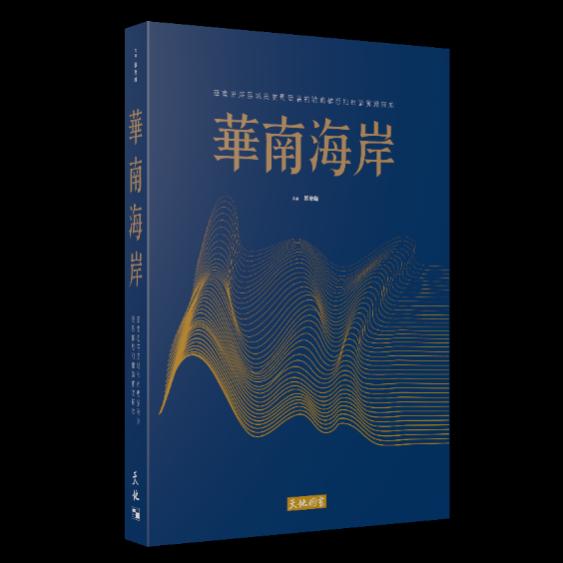
South China Coast builds on the forward-looking concepts of the “Hong Kong Bay Area,” the “Shenzhen–Hong Kong Bay Area” and the “South China Coast” proposed by Professor Woo Chia-Wei, the founding President of HKUST. It defines the South China coast as a continuous coastal economic belt with the Guangdong–Hong Kong–Macao Greater Bay Area as its core engine, encompassing eastern Guangdong, southern Fujian, western Guangdong, the Beibu Gulf and the Hainan Free Trade Port. The belt links the four provincial-level regions of Guangdong, Fujian, Guangxi and Hainan with Hong Kong and Macao, connecting four development regions under national strategies: the Guangdong–Hong Kong–Macao Greater Bay Area, the Hainan Free Trade Port, the Cross-Strait Integrated Development Demonstration Zone and the Beibu Gulf Economic Zone. The research team proposes an overarching vision of making the South China Coast Economic Belt a demonstration zone for the high-quality development of a coastal economic belt under Chinese modernization, contributing Chinese insights to the coordinated development of coastal economic belts around the world.
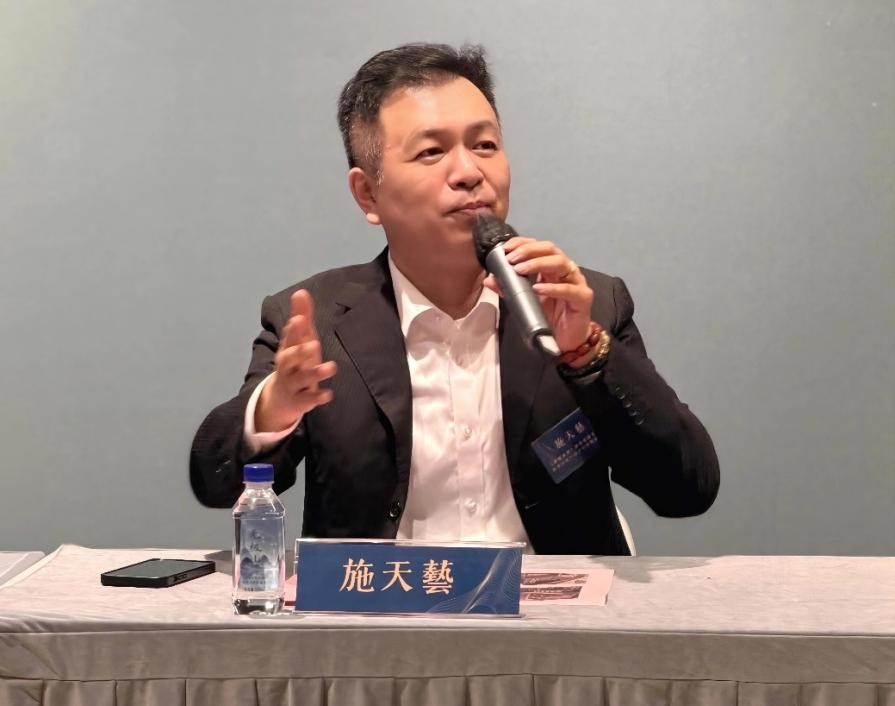
At the signing ceremony, Dr. Timothy Sze, Deputy Chair of the editorial committee of South China Coast and Director of HKUST’s Mainland Affairs Office, spoke on behalf of the committee and thanked colleagues at Cosmos Books and guests from all sectors.
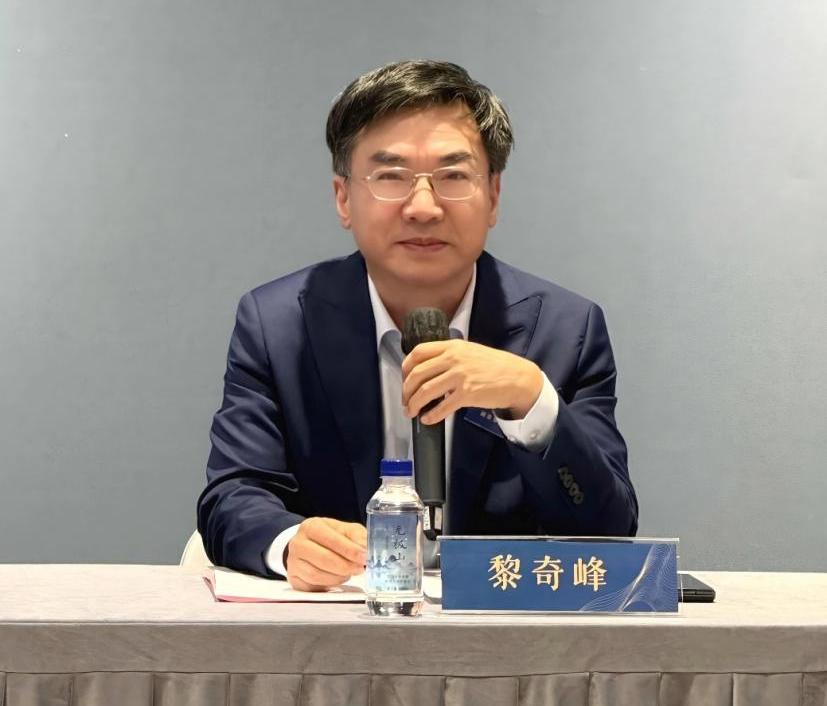
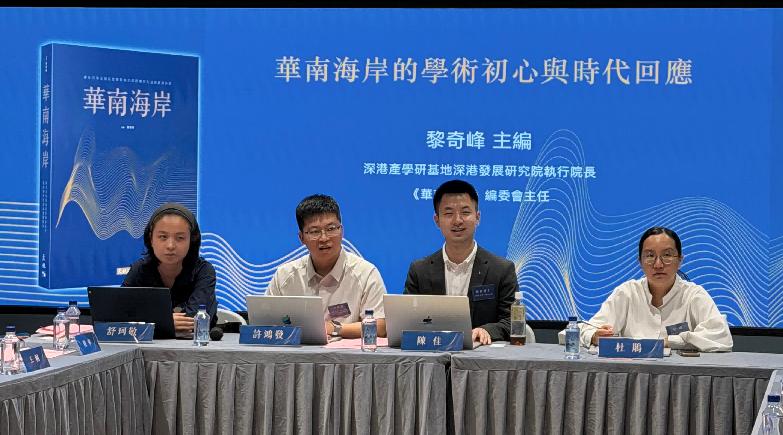
Li Qifeng, Chair of the editorial committee and Chief Editor of South China Coast, gave a keynote presentation entitled “The Scholarly Purpose of South China Coast and Its Response to the Times.” He traced the evolution from the “Shenzhen–Hong Kong Bay Area” to the “Guangdong–Hong Kong–Macao Greater Bay Area” and then to the “South China Coast,” explaining that the book carries forward and systematically develops Professor Woo Chia-Wei’s forward-looking ideas.
South China Coast uses long-term data from 2000 to 2023, covering a sample of 81 districts and counties and 948 listed companies. It employs econometric models, including difference-in-differences, to analyze empirically how the Greater Bay Area strategy affects high-quality development at the regional and firm levels. The research shows that regional integration has a significant positive effect, helping to improve firms’ financing environment and realize the benefits of supply-chain coordination. The positive effects of Greater Bay Area policies on surrounding areas remain statistically significant within a distance of approximately 250 kilometers.
On this basis, the research team proposes the “6–10 Programme,” encompassing six directions: knowledge connectivity, infrastructure connectivity, institutional connectivity, people-to-people connectivity, domestic connectivity and international connectivity. It comprises 60 major projects and recommendations for action, covering transport infrastructure, digital networks, institutions and rules, science and technology industries, cultural exchanges and international cooperation, and sets out a phased development roadmap toward 2049.
Members of the research team explained the different parts of the book. Dr. Du Juan noted that the resource endowments of the South China coast’s constituent regions are highly complementary, but their potential for cooperation has yet to be fully realized. The principal obstacle is insufficient capacity for cooperation across regions and institutional systems. She argued that a shift from “soft advocacy” to “hard mechanisms” is needed to turn “institutional differences” into “development advantages.” Using data visualization and geographic information, Xu Hongfa and Shu Kejing highlighted a structural feature of the Guangdong–Hong Kong–Macao Greater Bay Area: its leading aggregate economic scale coexists with substantial internal development disparities. This raised a central question: “Can the Greater Bay Area’s growth dividends cross administrative boundaries and continue to spread throughout the wider South China coastal region?” Chen Jia used difference-in-differences and spatial econometric models to quantify the contribution of regional integration to high-quality development and the geographic limits of its spillover effects, and introduced pathways for implementing the “6–10 Programme” action framework.
During the discussion, guests spoke in turn, including Cai Yi, a deputy to the 12th, 13th and 14th National People’s Congresses and a Hong Kong Justice of the Peace; Samson Tam, President of the Hong Kong Industry–University–Research Collaboration Association and a Justice of the Peace; Tu Jinbo, Chairman of Baige Online; Guo Lizhi, Chairman of Tongwei; Zeng Qiwen, Chairman of Kangweijian Biotechnology; Gao Jing, Founder of the Hong Kong Jinguo Institute; Zhao Weiying, representing Kingworld Medicines Group; Zhang Weijun, Vice President of Yuhetian Environmental Development Group; Shi Lin, Chairman of Guangdong Huaxiang Tourism Group; Liu Qiaoling, representing Shi Nengshi, President of the Shenzhen Fujian Chamber of Commerce; and Chen Yongsheng, President of the HKUST Shenzhen Alumni Association. They shared practical experience in Shenzhen–Hong Kong technology cooperation, business expansion across regions, supply-chain restructuring, AI-enabled cultural preservation, and cross-border research and development in health and wellness. Participants said that the strategic vision for the South China coast opens up new possibilities for businesses operating across regions. They expressed the hope that it would be elevated to a national strategy, providing enterprises with a clearer development roadmap.
The book has received high praise from numerous distinguished scholars and prominent figures from various sectors. Forewords were contributed by Professor Nancy Ip, President of HKUST; Professor Wei Shyy, its fourth President; and Professor Justin Yifu Lin, a member of the Standing Committee of the National Committee of the Chinese People’s Political Consultative Conference (CPPCC), former Vice President and Chief Economist of the World Bank, and Dean of the Institute of New Structural Economics at Peking University. More than twenty prominent figures from different sectors wrote reviews, affirming the book’s academic value and practical significance from a range of perspectives. They include Huo Zhenyu, a Permanent Director of the Fok Ying Tung Foundation; Chen Shiyi, a Member of the Chinese Academy of Sciences and President of the Eastern Institute of Technology, Ningbo; Chi Fulin, President of the China Institute for Reform and Development (Hainan); and Ke Liu, a Fellow of the Australian Academy of Technological Sciences and Engineering and Dean of the School of Innovation and Entrepreneurship at Southern University of Science and Technology. After reviewing the manuscript, Professor Gao Song, a Member of the Chinese Academy of Sciences and President of Peking University, described the book as presenting “a very ambitious vision, with considerable value as a reference for the high-quality development of larger regions of the country,” and recommended that copies be sent after publication to the National Development and Reform Commission and other relevant departments for reference.
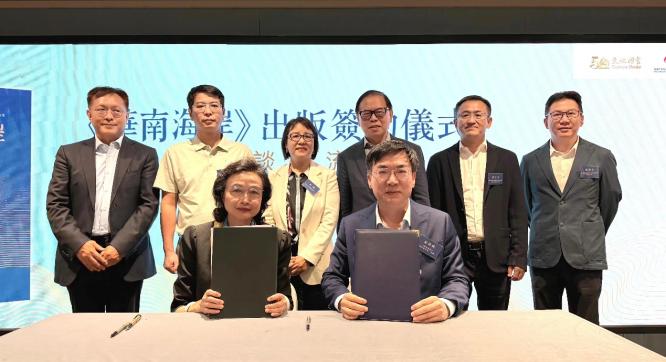
A publishing agreement signing ceremony was held during the event. Wu Jingyi, a member of the National Committee of the CPPCC and Chairman of Cosmos Books, and Li Qifeng, Chair of the editorial committee of South China Coast, signed the publishing agreement on behalf of the two parties. A donation ceremony followed. Institutions and individuals including the Hong Kong Jinguo Institute, the HKUST Shenzhen Alumni Association, Beijing Hengdu Law Firm, Xiayu Integrated Circuits (Shanghai) Co., Ltd., Kingworld Medicines Group, Zeng Qiwen, Gao Jing, Shi Lin, Liang Wei, Nie Fangjin, Zhao Lisheng and Shi Nengshi generously contributed funds to support publication of the book and related academic exchanges.
In his closing remarks, Hou Ming, Editor-in-Chief of Cosmos Books, said that developing the South China coast requires sustained, in-depth professional research by scholars, robust platforms for disseminating knowledge built by publishers, and, above all, the joint participation of all sectors of society. Cosmos Books, he said, would continue to follow development issues in South China and provide high-quality publishing services for related research.
With Hong Kong’s first Five-Year Plan announced and the 33rd APEC Economic Leaders’ Meeting taking place in Shenzhen on November 18–19, 2026, the publication of South China Coast not only carries forward and promotes Professor Woo Chia-Wei’s forward-looking ideas, but also uses empirical research to turn a broad vision into specific recommendations for action. It offers new ideas and proposals of value to academic research and policymaking on Hong Kong’s integration into and contribution to the country’s overall development, high-quality development along the South China coast, and economic cooperation across the Asia-Pacific region.
The signing ceremony and discussion were concise and well-paced, warm in atmosphere and rich in significance.